

Everything is transient.
Life comes and goes in the blink of an eye.
Friends come and go, employment opportunities rise and fade, people die, cities change, and the weather cycles through pleasant and punishing.
The only actual thing to expect from life is the unexpected—but in a way, the unexpected is the only thing we can count on, and it has been this way since the beginning of time.
One day you’re a UFC champion, the next you’re washed up.
One day, you’re a world-dominating empire, the next, you’re just a single page in a history book.
One day, you’re sitting on a life-changing sum of money, and the next day, you’re struggling to find money to buy groceries.
It is how it has always been.
“All things are in a process of change. You yourself are subject to constant alteration and gradual decay. So too the whole universe.”—Marcus Aurelius
The only difference now is that our abundance has led to weakness.
Our collective success as a species has eradicated most things that would have caused quicker alteration and a more rapid decay. We’ve made leaps and bounds in so many areas that most people now live relatively comfortable lives.
It’s not perfect; there is still an ultra-wealthy upper class.
Homelessness does exist. People still have no access to clean drinking water. Inequality of opportunities is still very real.
Poverty
Disease
Clothing
Housing
Employment
But the reality is that life in 2025 for the average man has become too easy.
Ease leads comfort. Comfort to neglect. Neglect to demise.
The demise in this case being any unforeseen circumstance or occurrence, aka the unexpected.
So the question then becomes, how do we steel ourselves against such things?
My suggestion… the scene set!
What is a scene set?
The scene set is that thing that takes place before you share some information that probably needs context before it can be properly comprehended.
One dictionary definition says, ‘to give someone information that is needed to understand something’.
“Before I tell the story, let me set the scene (for you).”
This is a crucial sales methodology that I have employed over the last 12 months as a private health consultant (admittedly, my sales manager would like me to employ it more frequently, but that’s a story for another day 😆).
When do we use the scene set?
Quite simply, it is used at the start of the call to frame how the conversation will look.
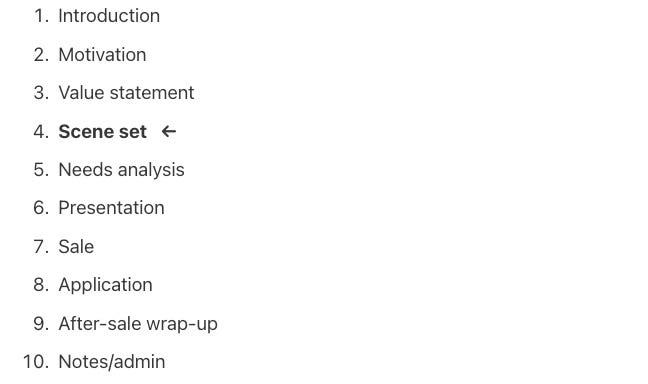
Here’s the framework so you get a sense for the placement:
Introduction
Motivation
Value statement
Scene set ←
Needs analysis
Presentation
Sale
Application
After-sale wrap-up
Notes/admin
The placement of the scene set is crucial in this context, but also when being applied in everyday scenarios.
It can’t come earlier; otherwise, it doesn’t have context.
It can’t come later, otherwise the prospect doesn’t know where they are in the call and what is going to happen.
The placement will make more sense in a moment.
Why do we use the scene set, and what happens if we don’t use it?
We use it to give context, aka to make things make sense.
To alleviate the calamity of finding yourself in a place that you didn’t expect, being asked questions you didn’t plan to answer.
It’s a power move to show you know what you’re doing and that you’re in control.
I was having a chat with my general manager recently, and he shared an analogy to illustrate the importance of it.
He said (paraphrasing)…
Imagine you call a friend and you tell them that you’re on the way to pick them up, without giving them any information. They get in the car, and you don’t give them any more context on what is about to happen, they’re obviously going to be a little anxious about what is happening. Then you say that you’re driving 14 hours straight to Brisbane, they freak out and ask to exit the vehicle immediately.
Now imagine the same scenario, but you call them first and tell them your exact plans and that you’re heading out of town for the weekend, to cancel their plans, pack a bag and dress comfortably. They can either say no, or they can be prepared for what is going to come next.
The scene set avoids that moment of shock and proactively diffuses any objections.
This is the power of the scene set—it can make or break any scenario.
It’s a tool that prepares you for the unexpected.
As well as the initial scene set, I like to use mini scene sets along the way.
I use them because every time I introduce a new concept or element of the sales call, there’s a chance I might lose the prospect, so I proactively dissuade them from losing interest by guiding them through the call.
Application to everyday life to prepare you for the unexpected
Every time we walk out the front door, we increase the chance of running into something unexpected.
A car accident
A global pandemic
An abusive prospect
A disgruntled co-worker
A tram that is running late
A laptop that refuses to start
Catastrophe awaits us at every single turn.
You can go through life assuming that everything is going to make sense and that only good things are going to happen to you.
But what happens when they don’t?
Do you curl up into a ball and wish it away? Or avoid the problem?
Most do.
Our world has softened due to an abundant modern society that serves up opportunity and reward on a silver platter. We expect things to go a certain way, and usually we get them.
But if we don’t? What happens when the unexpected takes place?
Setting the scene allows us to take the power back and control a situation that otherwise would be uncontrolled.
Don’t forget the placement of the scene set either…
Not first, not last, just after the introduction and once the motivation is understood and the value has been created—but why is that important?
Going back to the analogy from my GM…
Me: Hey it’s Sav, you’re best of 10 years, what do you wanna do this weekend? ←introduction explains who you are and begins to build rapport
Friend: I dunno, something fun ← states motivation
Me: Oh, dope, so you wanna do something fun this weekend, oh man, I can definitely make sure we do something fun this weekend ←re-state and confirm motivation, then offers value
Friend: Sounds good ←getting some buy in and rapport
Me: I’m gonna get ready now, then jump in the car to come pick you up in about an hour… you get dressed in something comfortable and pack a bag… then we drive to Brisbane for the weekend, I’ve got money for petrol, so don’t worry about that… we find a backpackers to crash, get lit and return Sunday night around 10pm, so you’re back for work… ←scene set
You might still get some objections here, but you have prepared your friend as best you can for any unexpected occurrences.
Human beings are adaptable if they are informed.
Using the scene set (and mini scene sets), you can prepare yourself for the randomness of life and prepare the people around you for what is/isn’t going to happen in any given scenario.
Every time you put yourself in a new room, enter a new context or begin a conversation—set the scene and take control.
It doesn’t matter the person or place:
A new day…
Your next prospect…
The quarterly team meeting…
Your loving but needy girlfriend…
The tough conversation with a close friend…
The abundant but toxic technological society we inhabit…
Using the scene set in everyday life prepares you for the unexpected.
You decrease the chances of something unexpected totally derailing your momentum and peace.
With gratitude,
SAV
If you really want to support me, there’s 3 other ways to do that:
Purchase the Champ Camp EP: My latest EP is out now and you can purchase it here. I poured my soul into this and I look forward to everyone hearing it.
Follow me on Youtube: All my podcasts, interviews, music videos and a whole heap more, all in one place.
Lil Gratitude Journal: My gratitude journal has been carefully designed for the busy modern-day creative/entrepreneur. It’s efficient, effective and affordable (and makes for a great gift).