

After months of struggling to get any traction and consistency posting Substack Notes, I made a breakthrough…
Not in terms of engagement or audience growth.
But in simply posting the bloody things.
I trialled a few workarounds and used some apps before eventually saying ‘eff it’ and building my own scheduling tool in Claude Code… only for my go-to scheduling tool, Typefully, to ship a Substack Notes update just days later 🤦♂️.
It was a bittersweet moment.
The sense of accomplishment wrestled with my own feeling of frustration that I had waited so long and the simultaneous relief that the problem had been solved.
That moment taught me some beautiful lessons.
Some ancient, some not so, but all increasingly more relevant.
Context
I have been writing newsletters and posting short-form content for years.
Since 2022, I have written 150+ newsletters, 100ish long-form posts (threads etc) and close to 1000 pieces of short-form writing (tweets, single ideas).
I love it.
This is my way of working through ideas, expressing my thoughts and hopefully sharing some knowledge and insight for those just behind me.
Most of that writing has been done on X and through newsletter platforms like Kit, but over the last 12 months I have made a genuine effort to write consistently and potentially even grow my Substack audience.
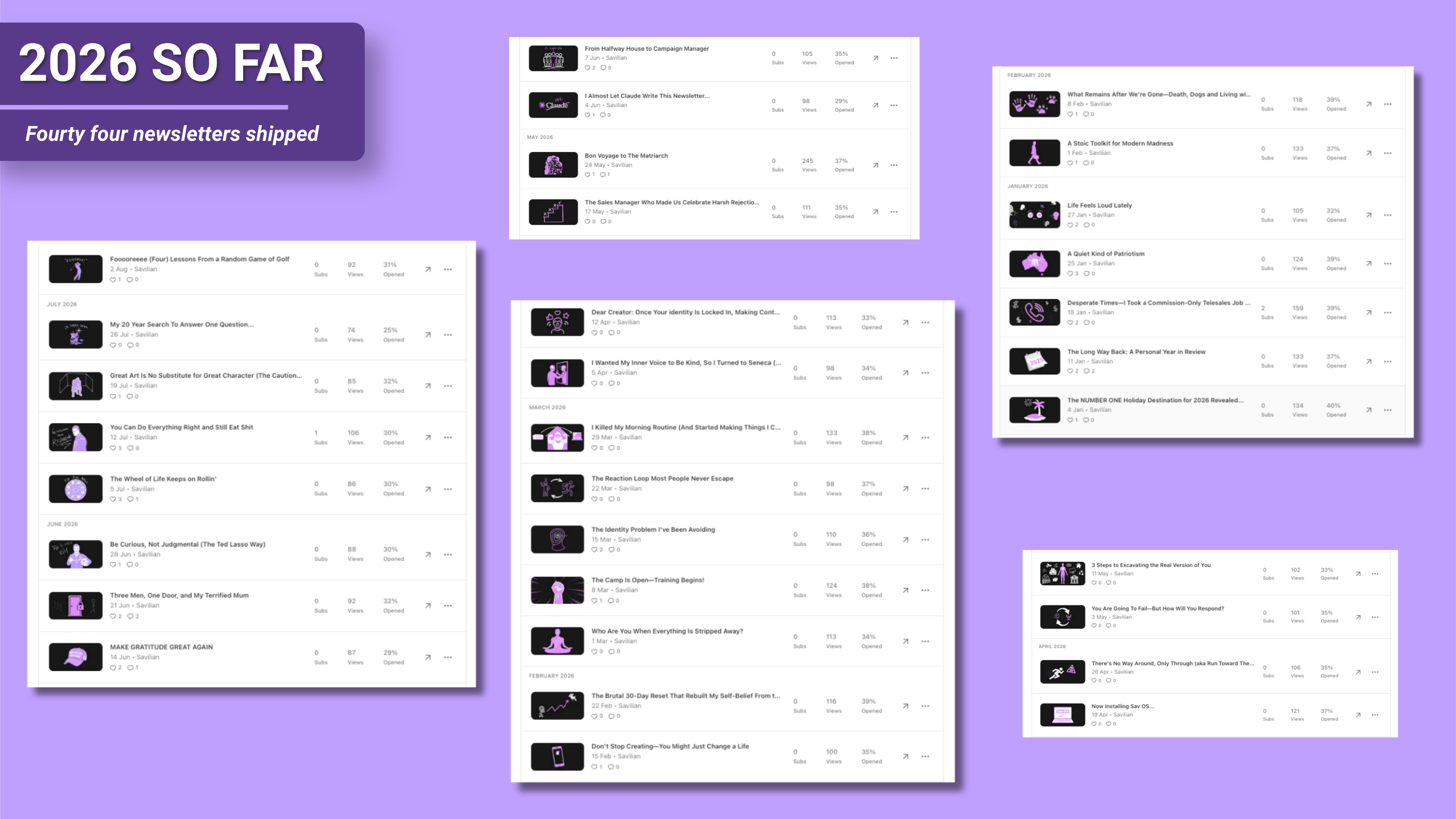
This year alone I have written 44 newsletters!
I knew that posting notes and engaging with the Substack community would help my efforts, so I tried to do more.
But kept getting stuck.
For some time, Substack made it difficult to schedule short-form content.
Working full time and creating any content is tricky enough, but having to post lots of content throughout the week without the time to do it every day was proving very, very difficult.
My tool of choice for posting to X/Threads was Typefully, but they had not built out a Notes feature. So I was stuck trialling different workarounds.
First, I tried writing them all in my Apple Notes once a week and then manually posting each day.
Then I tried a popular tool called Writestack, which was great, but I couldn’t justify the spend on something that was not earning anything.
In March this year, Substack rolled out native Notes scheduling, which was solid but not the best in terms of UX.
Then, after some great interactions and conversations with a colleague at work, I finally decided to pull the trigger.
Solution
One morning a week or so ago, I sat down with my coffee and said ‘enough is enough’.
Despite my reservations (none of which had any grounding in reality), I dove headfirst into Claude Code and started tinkering away on my own solution.
Two things were happening concurrently to force this action:
I got my first paid subscriber on Substack and wanted to go harder on my writing.
My new role as a campaign manager was chewing up more and more time.
I needed to build something that would make the process easier.
So I did.
Claude and I went back and forth, and in a few short hours, I was done.
A simple scheduling tool that I was able to launch from Claude Code, schedule all of my Notes for the week and then carry on with life’s more pressing demands.
Super straightforward, with all of the key features I needed:
Easy deletion
Week vs month view
Drag & drop rescheduling
Simple note creation button
No bells and/or whistles to be found
It’s not perfect, but I made it, and I am proud of that fact.
I had a problem, and I solved it.
Typefully Update
A few days later (literally 3 days), my favourite scheduling tool decided to release an update featuring Substack Notes scheduling.
I have been using Typefully on and off for 2-3 years.
Simple. Elegant. No fluff.
The main writing page is something I have genuinely enjoyed using to create.
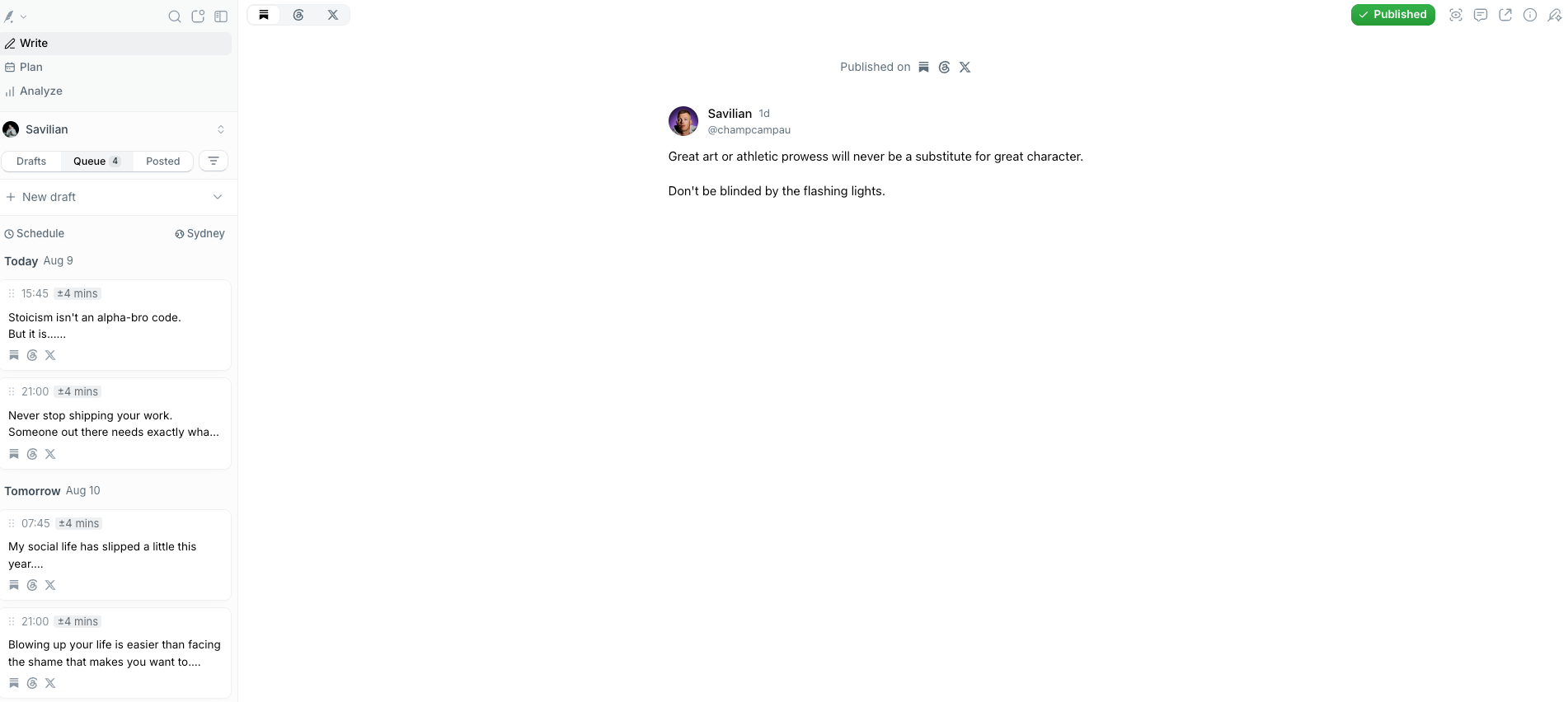
Typefully was/is great, but the lack of Substack Notes was something that had brought up some resistance inside of me.
Not just to Typefully, but to Substack and the whole idea of going all-in.
It’s the resistance that Steven Pressfield talks about.
That gnawing feeling that you could/should be doing more, but continually find ways to delay your potential, as it is easier to compensate with the excuse that everything is just too difficult etc.
Blah blah blah!
I let resistance stop me from finding a solution, until I didn’t, but by then the goalposts had moved.
And here are my abstract takeaways from this experience…
Takeaways
1. No One Is Coming to Save You
For months I let the resistance win.
It lingered inside of me as I patiently waited for someone to solve my problem, but no one was coming.
And that’s the thing—they never are…
Every time we feel resistance, whether financially, mentally, emotionally, creatively or physically, we must meet it. We need to meet it head-on, acknowledge it and find a way through.
You can’t be complacent.
You can’t let it win, especially not now.
2. Act Now, Build Fast
Part of not letting the resistance win is taking action.
In this scenario, I had ample time to take massive action, build something, iterate and then build something better.
Instead of delaying for months, wasting time and opportunity, I could’ve been creating.
All it would’ve taken was to build something ie. to act.
The reason is twofold:
Act = action creates energy, and energy builds momentum.
Fast = implies adherence to the rules of the game, the game being the one we all play every day… life—a life that is increasingly governed by AI proficiency.
You’re always going to have great ideas; don’t wait on them.
Don’t delay because the timing isn’t right.
Do the thing. Act now. Build fast, and if you must, build some more.
3. Create Workflows, Not Tools
One thing I had seen floating around in AI content was the idea of building workflows over the tools.
Basically, don’t waste time on a new app that is just a UX wrapper for an LLM.
The reason…
This space and technology are moving too quickly. Your idea is likely to become obsolete in months or weeks.
The solution…
Build the workflows with ready-available tools.
But why?
Because things are moving insanely fast and you’re only one update or one failed math class away from someone building the exact same thing with slightly more features at a slightly lower price point.
On the other hand, with the right workflows/agents and systems, you become infinitely more powerful and much harder to replace.
Tools and software will come and go.
But having a fundamental understanding of systems, structure, workflows and how everything fits together requires taste, logic and perseverance. All of which are much harder to replicate.
4. Be Proud of What You Achieve (But Always Expect More)
Despite the tsunami of emotions that this adventure caused, I was grateful for it.
Knowing that I had the potential to solve my own problem, but delaying the actions required before finally doing the work to solve the problem, and then having it made redundant in a matter of moments, has been humbling to say the least.
I did eventually overcome the resistance and do the thing. I’m proud of that.
I’m aware that this is likely to happen again. I will be ready.
In combat sports, coaches and experts will talk about ‘taking the space’. Basically, it means to press forward into the vacant space in front of you in order to press an advantage or manipulate the momentum of a fight.
Throughout this experience, I didn’t take the space.
I played too defensively, missed an opportunity and had to adjust. Life, like combat sports, requires you to march forward, take and protect your advantage.
It’s much harder to perform well on the back foot.
Final Thoughts
I don’t really have anything too profound, just that it was a funny sequence of events that I wanted to share. Comical even.
I spose the main takeaway is to remember your own power.
You can do anything… if you really want to.
Whatever you are resisting right now, find a way to confront and overcome it.
Resistance told me that building my own tool was too hard, too technical, something that other people do. Resistance was wrong—like it always is.
So, next time the space opens up in front of me, I’m taking it.
No hesitation. No waiting.
No one’s coming to save me; thank the AI overlords for that!!
That’s it from me.
With gratitude,
SAV
If this one resonated, subscribe below.
Every week I show up, do the work and share what I learn wrestling ideas into something real.